1-800-868-2450
My Account | Cart | Checkout
Choosing the best rotary air compressor is not a simple horsepower comparison. The right choice depends on demand, duty cycle, air quality, installation space, and maintenance access. A small workshop may value low purchase cost. A food-processing plant may need oil-free air, stainless piping, and dependable filtration.
Ron Marshall, a respected compressed-air systems specialist, has stated, “Compressed air is often the most expensive utility in a plant.” That warning deserves attention. A compressor can look efficient on its nameplate while losing energy through leaks, pressure drops, poor controls, or unnecessary unloading. I have seen a clean machine room hide a damaged hose and an oversized compressor running for hours without production demand.
The best rotary air compressor should therefore match the real air profile, not an optimistic estimate. Measure peak flow. Check operating pressure. Record daily load changes. Review the motor, inverter, cooling system, noise level, and service network. These details matter when the compressor runs beside workers every day.
There is no universal winner.
An oil-injected screw compressor may offer strong value and simple servicing. A variable-speed model can reduce waste under changing demand, but its controls need skilled attention. An oil-free rotary air compressor may protect sensitive processes, although its initial cost can be higher.
This guide compares those trade-offs with practical judgment. Some recommendations remain imperfect because every plant behaves differently. That uncertainty is worth admitting before any purchase.
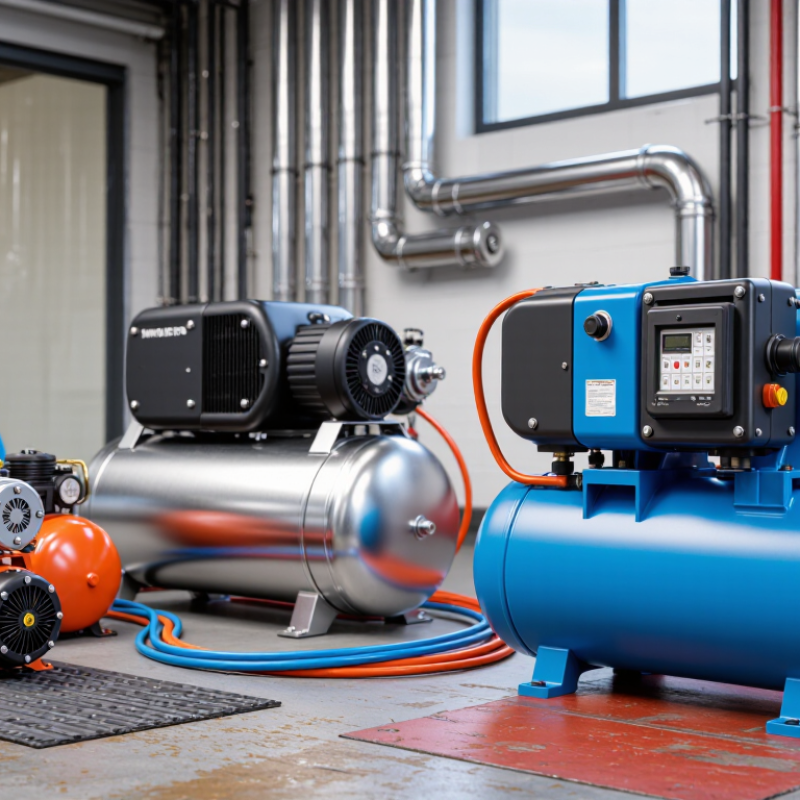
A rotary air compressor is defined by how it traps and compresses air. Rotating elements reduce the air volume continuously. Common designs include screw, vane, scroll, and lobe mechanisms. The motor only supplies motion. It does not define the compressor type.
The real test is operating behavior. Rotary units usually provide steadier airflow than reciprocating units. They suit production lines, workshops, and systems requiring long duty cycles. Oil-injected models use lubricant for sealing, cooling, and noise control. Oil-free models separate compression from lubrication, which supports sensitive processes. However, “oil-free” does not remove every contamination risk. Air treatment and maintenance still matter.
Energy use deserves closer attention. The U.S. Department of Energy reports that compressed air can consume about 10% of industrial electricity. Its compressed-air guidance also identifies leaks as capable of wasting 20% to 30% of compressor output. That makes pressure settings, leak surveys, filtration, and control strategy as important as the compressor itself. ISO 1217 provides methods for testing compressor performance, while ISO 11011 addresses compressed-air system energy efficiency. These standards improve comparison, but specifications can still hide installation losses. A practical mistake is choosing by maximum pressure alone. The better question concerns delivered flow, air quality, load pattern, cooling conditions, and service access. The “best” rotary compressor may be the quieter, smaller unit that runs efficiently—not the largest one on the catalog page.
What Is the Best Rotary Air Compressor?
How Rotary Air Compressors Work
A rotary air compressor traps air and compresses it continuously. Inside a rotary screw design, two precisely shaped rotors turn within a small chamber. Air enters through the inlet, fills the spaces between the rotors, and moves toward the discharge side. As those spaces become smaller, pressure rises. A thin oil film may seal clearances, cool the compression area, and reduce friction. Oil-free systems use different clearances and cooling methods.
The process feels simple. It is not. Rotor timing, inlet control, temperature, and filtration all affect output. The U.S. Department of Energy reports that compressed-air systems can represent about 10% of industrial electricity use. Its compressed-air guidance also notes that leaks may waste 20–30% of compressor output in poorly maintained systems. That makes operating conditions as important as the machine itself.
Performance should be checked using free air delivery, discharge pressure, and specific power. The Compressed Air and Gas Institute emphasizes standardized testing for comparing these values. A higher pressure setting can increase energy use without improving production. I have seen systems run continuously while a loose fitting quietly releases air near a workbench. That detail is easy to miss. The International Energy Agency also identifies motor-driven systems as a major industrial efficiency opportunity, supporting careful load management and maintenance. Yet no report replaces measurements from the actual plant. Pipe length, shift patterns, moisture, and demand changes can make a theoretical comparison imperfect.
| Rotary Compressor Type | How It Works | Typical Pressure Range | Typical Airflow Range | Duty Cycle | Energy and Operating Characteristics | Maintenance Considerations | Best-Suited Applications |
|---|---|---|---|---|---|---|---|
| Rotary Screw | Two intermeshing helical rotors continuously trap and compress air as the air moves along the rotor length. | Approximately 5–15 bar (72–218 psi) for common industrial models; higher-pressure versions are available. | Approximately 0.2–100 m³/min, depending on compressor size and pressure. | Well suited to continuous operation | Provides a steady flow with relatively low pulsation. Variable-speed versions can reduce energy use when demand changes. | Requires scheduled inspection of filters, separators, oil, belts or couplings, and rotor-system components. Oil-free designs have different service requirements. | Factories, automated production lines, workshops, packaging, and applications with sustained air demand. |
| Rotary Vane | A rotor mounted eccentrically inside a housing uses sliding vanes to form chambers that decrease in volume and compress the air. | Approximately 4–10 bar (58–145 psi) for many general-purpose units. | Approximately 0.05–15 m³/min, depending on size and configuration. | Suitable for regular and intermittent operation | Compact and generally smooth-running, with moderate airflow pulsation and a relatively simple mechanical arrangement. | Vanes gradually wear and may require replacement. Lubricated models also require oil and separator maintenance. | Small and medium workshops, laboratory equipment, printing, pneumatic controls, and light industrial tools. |
| Rotary Lobe | Two counter-rotating lobes move air from the inlet to the outlet. The air is usually compressed by system backpressure rather than inside the casing. | Typically up to approximately 1 bar (15 psi) for low-pressure blower service; special designs may operate at higher pressure. | Approximately 0.5–200 m³/min, depending on blower size and pressure. | Well suited to continuous operation | Designed for high-volume, low-pressure airflow. Pulsation and noise can be higher than with screw compressors unless accessories are installed. | Maintenance commonly includes checking bearings, timing gears, seals, lubrication, filters, and inlet or discharge conditions. | Wastewater aeration, pneumatic conveying, combustion air, bulk-material handling, and ventilation. |
| Rotary Scroll | Two spiral elements orbit relative to one another, progressively reducing the volume of trapped air pockets toward the discharge port. | Approximately 6–10 bar (87–145 psi) for many small and medium systems. | Approximately 0.1–10 m³/min, depending on the number of scroll modules. | Suitable for continuous operation when correctly sized | Low vibration and low noise. Oil-free compression is available, making it useful where clean air is important. | Scroll tips and seals require periodic inspection. Repairs may require specialized service because of the precision of the scroll elements. | Medical facilities, laboratories, electronics, food processing, dental systems, and low-noise installations. |
| Liquid-Ring Rotary | An eccentric impeller rotates in a liquid ring, creating variable-volume chambers that draw in and compress gas. | Usually used for low-to-moderate pressure or vacuum service; exact limits depend on liquid temperature and design. | Approximately 0.1–100 m³/min, depending on equipment size and operating conditions. | Suitable for continuous process operation | Handles wet, humid, or contaminated gas better than many dry compression technologies. Performance is affected by liquid temperature and seal-liquid conditions. | Requires management of seal liquid, corrosion control, filtration, bearings, seals, and liquid temperature. | Chemical processing, vacuum service, vapor handling, gas recovery, and applications involving moisture or condensable vapors. |
| Rotary Claw | Two claw-shaped rotors rotate without contact, moving and compressing air through changing chamber volumes. | Commonly approximately 1–4 bar (15–58 psi) in pressure service, with model-specific limits. | Approximately 0.1–20 m³/min, depending on size and pressure. | Suitable for continuous operation | Non-contact compression can reduce wear and contamination risk. Oil-free airflow is available in many designs. | Maintenance typically focuses on inlet filters, bearings, seals, cooling systems, and clearances between the rotors. | Vacuum lifting, pneumatic conveying, packaging, wastewater aeration, and clean-air applications. |
| Selection guidance: The best rotary air compressor depends on required pressure, airflow, operating hours, air-quality class, noise limits, available space, and lifecycle cost. The pressure and airflow figures above are representative ranges rather than universal limits; actual performance varies by compressor design, speed, temperature, altitude, and manufacturer specifications. | |||||||
The best rotary compressor depends on airflow, pressure, duty cycle, and air-quality requirements. A rotary screw compressor suits factories that need steady air throughout long shifts. It can power packaging lines, pneumatic tools, and automated machinery. Oil-injected models usually offer efficient operation and lower purchase costs. Oil-free versions fit applications where clean air is essential, such as food processing or electronics assembly. Check the required pressure at the point of use, not only at the compressor outlet.
A rotary vane compressor works well in small workshops and light industrial settings. It has a compact design and handles intermittent demand effectively. However, vane wear may increase when dust enters the intake system.
A scroll compressor provides quiet, low-vibration operation for laboratories, clinics, and indoor technical rooms. Its airflow is often limited, so it may struggle with several high-demand tools.
For very large facilities, a centrifugal compressor can deliver high airflow efficiently when demand remains stable. It performs poorly when usage changes sharply.
Installation details matter as much as the compressor type. Leave space for cooling, replace filters according to actual operating conditions, and inspect condensate drains regularly. Quiet matters. Energy efficiency is not everything. A lower-cost unit may consume more electricity over several years. I have seen specifications chosen too quickly, especially when buyers ignore pressure drops in long pipes. A careful load profile, including peak and idle periods, usually produces a more reliable choice. No selection is perfect; operating habits often expose weaknesses that catalog figures hide.
What Is the Best Rotary Air Compressor?
The best rotary air compressor depends on efficiency, capacity, and operating costs. A high purchase price may still provide better value over several years. Compare motor power with delivered airflow, not advertised horsepower alone. Check the specific energy rating, usually measured in kilowatts per 100 cubic feet per minute. Lower numbers generally indicate better efficiency.
Capacity must match real demand. A workshop using several tools may need steady airflow, not merely a high peak rating. Measure pressure at the point of use, because long pipes, filters, and leaks reduce available pressure. Oversizing also creates waste. The compressor may cycle inefficiently or operate below its ideal range. In field checks, small leaks around fittings often cost more than expected. That detail is easy to miss.
Tips: Record weekly operating hours, average pressure, and peak airflow before comparing models. Estimate electricity costs using your local tariff. Include filter replacement, lubricant, servicing, and cooling requirements. Ask for tested performance data, not vague efficiency claims. A basic spreadsheet helps, but it is not perfect. Changing production schedules can alter the result. Review the calculation after one month of actual use.
For a fair comparison, this chart uses a representative 10 m³/min demand at 7 bar(g), 8,000 operating hours per year, and an electricity rate of $0.12/kWh. Lower specific power and lower annual electricity cost indicate better efficiency.
| Compressor Configuration | Specific Power kW/(m³/min) |
Annual Electricity Cost |
|---|---|---|
| Fixed-speed rotary screw | 6.8 | $65,280 |
| Variable-speed rotary screw | 6.2 | $59,520 |
| Two-stage rotary screw | 5.8 | $55,680 |
The two-stage rotary screw configuration provides the lowest modeled energy consumption, while a variable-speed compressor can reduce waste when demand changes throughout the day. Actual results depend on pressure, inlet conditions, controls, leakage, maintenance, and the site load profile.
What Is the Best Rotary Air Compressor?
The best rotary air compressor depends on your air demand, working pressure, and operating environment. Rotary screw models suit factories needing steady airflow, while rotary vane units may fit smaller workshops. Check free air delivery, not only motor horsepower. A compressor rated at 7.5 kW may not provide enough air for several tools running together. Compare the required flow at your actual pressure, such as 7 or 8 bar.
Think about duty cycles and future production. A machine running near full capacity will consume more energy and may need frequent maintenance. In practical installations, heat, dust, and poor ventilation often cause avoidable shutdowns. Leave clear space around the intake and cooling system. Review noise levels if the compressor operates near workers. Also examine the dryer, receiver tank, filters, controls, and replacement parts. The compressor is only one part of a reliable air system.
Tips: Record your peak and average air demand for one week. Check pressure drops at the farthest outlet. Choose variable-speed control only when demand changes often. My early mistake was selecting based on purchase price alone. Energy and maintenance later cost more than expected. Ask a qualified technician to verify the sizing, electrical supply, ventilation, and safety controls before installation.
I&M Industrials Inc.
10 Akron Drive
Greenville SC 29605
Phone: 864-277-2450
GSA Number – GS07F0379Y