What Are the Top Compressed Air Compressor Types in 2026?
Compressed air often stays invisible until a production line slows or a leak hisses beside a tool. Choosing a compressed air compressor in 2026 means matching equipment to actual demand. That requires checking pressure, flow, air quality, duty cycle, and room for future growth. No single type wins.
The U.S. Department of Energy’s Improving Compressed Air System Performance: A Sourcebook for Industry reports that compressed air uses about 10% of U.S. industrial electricity. DOE guidance also notes that leaks may waste 20% to 30% of compressor output in poorly maintained systems. These figures make operating conditions as important as a machine’s advertised efficiency. A technically impressive model can still be a poor fit.
Reciprocating compressors often suit intermittent demand, while rotary-screw units commonly serve steady production. Centrifugal machines are typically considered for large, continuous flows. Scroll compressors can suit smaller applications where quiet operation matters. Oil-free and oil-injected describe lubrication choices, not separate compressor architectures. The categories overlap in real installations, and buying guides sometimes make the choice look simpler than it is. A careful comparison should weigh purchase cost, maintenance, air quality, and energy use together. The sections ahead examine the leading types, their practical strengths, and the trade-offs buyers should check before selecting a system.
What Is a Compressed Air Compressor and How Does It Work?
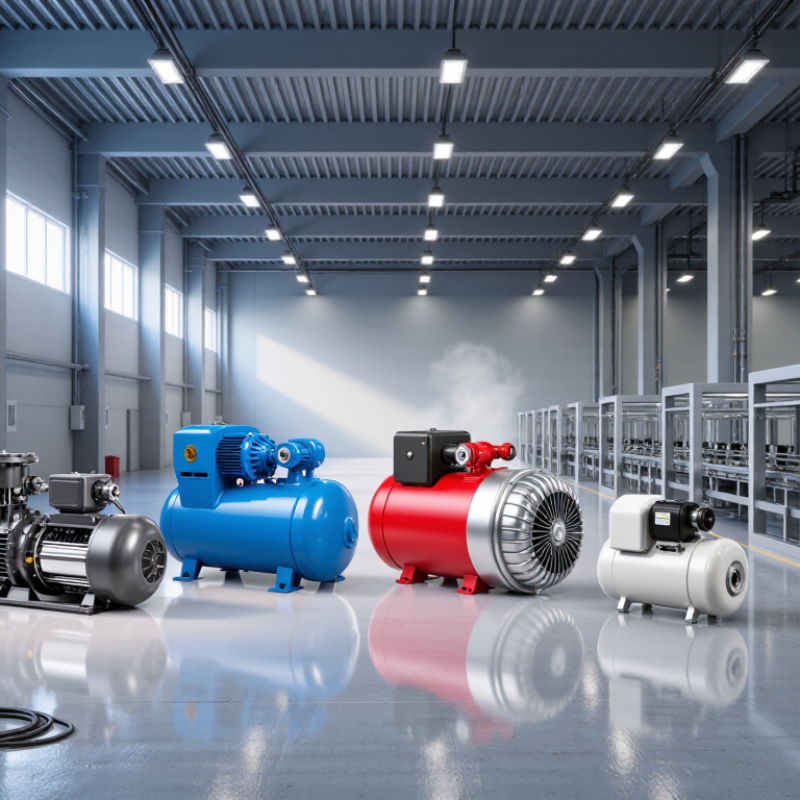
A compressed air compressor draws in air from the room and squeezes it into a smaller space. This raises the air’s pressure, allowing it to power tools, move materials, or support production equipment. In many systems, a motor drives a pumping element, such as a piston or rotating screw. The compressed air may then pass through a cooler, moisture separator, and filter before entering a storage tank. The tank helps meet short bursts of demand. Simple idea. Careful setup matters.
The compressor’s controls monitor pressure and switch the machine on or off, or adjust its output, as demand changes. Pressure alone does not tell the whole story: airflow, air quality, and usage patterns also affect performance. For example, a workshop using an air tool intermittently may need a different setup from a line that runs continuously. It is tempting to assume a larger compressor is always safer, but oversized equipment can waste energy and cycle poorly. That deserves a second look.
Tips: Check the pressure and airflow requirements of each tool, then compare them with the compressor’s rated output. Drain collected tank moisture regularly, and keep intake vents clear. A gauge helps, but it cannot reveal every leak; listen for faint hissing and inspect fittings during routine maintenance.
What Are the Top Compressed Air Compressor Types in 2026? - What Is a Compressed Air Compressor and How Does It Work?
A compressed air compressor takes in atmospheric air, uses mechanical energy to reduce its volume and raise its pressure, and delivers the stored energy for tools or processes. Most systems also use a receiver tank, controls, filters, and a dryer. Compressor suitability depends on required pressure, airflow, duty cycle, air-quality needs, and operating conditions.
| Compressor type | How it works | Typical demand profile | Pressure suitability | Air quality considerations | Strengths and limitations | Common applications |
|---|---|---|---|---|---|---|
| Reciprocating (piston) | A piston moves inside a cylinder, drawing air in on one stroke and compressing it on another. | Intermittent or modest air demand; often suited to start-stop operation. | Available in single-stage and multistage designs; multistage units can serve higher-pressure applications. | Lubricated models can introduce oil carryover. Oil-free versions are available; filtration and drying may still be needed. | Often straightforward to install and suitable for intermittent use. Can be noisier and produce more pulsation than many continuous-duty designs. | Workshops, garages, small production areas, and applications requiring intermittent compressed air. |
| Rotary screw, oil-injected | Two rotating helical rotors trap and compress air as it moves through the air end; oil helps seal, cool, and lubricate the compression process. | Continuous or frequent demand, including industrial duty cycles. | Commonly used for general-purpose plant air; pressure capability depends on the model and configuration. | Oil is present in the compression chamber, so downstream separation and treatment are needed when low oil content is required. | Well suited to steady operation and can provide a continuous supply. Requires oil management, service, and appropriate air treatment. | Manufacturing, assembly lines, packaging, and general industrial air systems. |
| Rotary screw, oil-free | Screw rotors compress air without oil in the compression chamber; some designs use multiple stages or other cooling methods. | Continuous demand where air purity is important. | Available for a range of industrial pressures; the required pressure and flow determine the suitable design. | Designed to avoid oil entering the air during compression. Intake contaminants, piping, and downstream equipment can still affect delivered air quality. | Useful where oil contamination risk must be minimized. Typically has higher purchase and maintenance considerations than comparable oil-injected designs. | Food and beverage processing, pharmaceutical production, electronics, and other applications with strict air-quality requirements. |
| Centrifugal | A high-speed impeller accelerates air, and a diffuser converts much of that velocity into pressure. Multiple stages can raise pressure further. | Large, steady airflow demand; performance is best when operation is matched to the required flow range. | Typically used in systems requiring substantial airflow at industrial pressures; multistage configurations support higher pressures. | Compression can be oil-free, but air quality still depends on intake conditions, seals, and downstream treatment. | Can deliver high volumes of air with smooth, continuous flow. Often less suitable for small or highly variable demand without appropriate controls. | Large industrial plants, chemical facilities, refineries, and central utility systems. |
| Rotary vane | An eccentric rotor turns inside a housing; sliding vanes form chambers that shrink and compress the air. | Steady, moderate demand in compact installations. | Pressure range depends on the design and number of stages; commonly selected for general-purpose compressed-air duties. | Many models are oil-lubricated and require oil separation and filtration. Air-treatment needs depend on the end use. | Compact and capable of smooth operation. Vane wear and lubrication requirements should be considered in maintenance planning. | Small industrial systems, workshops, and equipment installations where a compact compressor is useful. |
| Scroll | One spiral-shaped scroll orbits against another fixed scroll, progressively reducing the volume of trapped air pockets. | Small to moderate demand, often supplied by compact or modular units. | Generally used for low- to moderate-flow duties; model-specific pressure limits should be checked against the application. | Oil-free scroll designs are common, though air quality still depends on the complete system and required treatment. | Compact and typically low in vibration, with few moving parts in the compression mechanism. Not usually selected for very large airflow demand. | Medical and laboratory systems, small clean-air applications, and quiet equipment installations. |
Note: Capacity, pressure, efficiency, noise, and air-quality performance vary by design and operating conditions. Select equipment using the required flow at the point of use, working pressure, duty cycle, air-quality specification, and total system demand—not compressor type alone.
Related Posts
-
Top Industrial Air Compressor Suppliers for Global Buyers
-
What is an Air Compressor Air Dryer and How Does It Work?
-
China Best Industrial Air Compressor Manufacturers?
-
2026 Best Gas Air Compressor Types for Global Buyers?
-

2026 Best Gardner Denver Air Compressor for Global Buyers?
-
What is an Air Compressor Air Dryer and How Does It Work?