1-800-868-2450
My Account | Cart | Checkout
Industrial plants depend on reliable air, but the right system is rarely the biggest one. A food-packaging line may need clean, dry air at steady pressure, while a metal shop may face sharp demand spikes. Compressor type matters. So do filtration, dryers, storage, controls, pipe layout, and maintenance access. A poorly sized system can waste energy, cause pressure drops, or leave tools struggling at the far end of a long pipe run.
Compressed-air educator Ron Marshall has emphasized the value of measuring actual demand instead of relying on equipment ratings alone. In paraphrase, his practical advice is: measure the whole system, not just the compressor. That principle guides this look at 10 Best Air Systems for Industrial Applications. Each option should be judged against operating pressure, air quality, duty cycle, expansion plans, and the cost of downtime. A receiver tank near a busy workstation, for example, can help smooth short bursts of demand. Small details matter.
There is no universal winner. A system that suits a continuous-process plant may be excessive for a smaller workshop. Specifications also cannot replace a site assessment, and real demand may change between shifts. That is worth admitting. This guide compares common industrial air-system choices, highlights their strengths and trade-offs, and offers practical questions to ask before purchase. Use it as a starting point, then verify performance needs with qualified engineers and measured plant data.
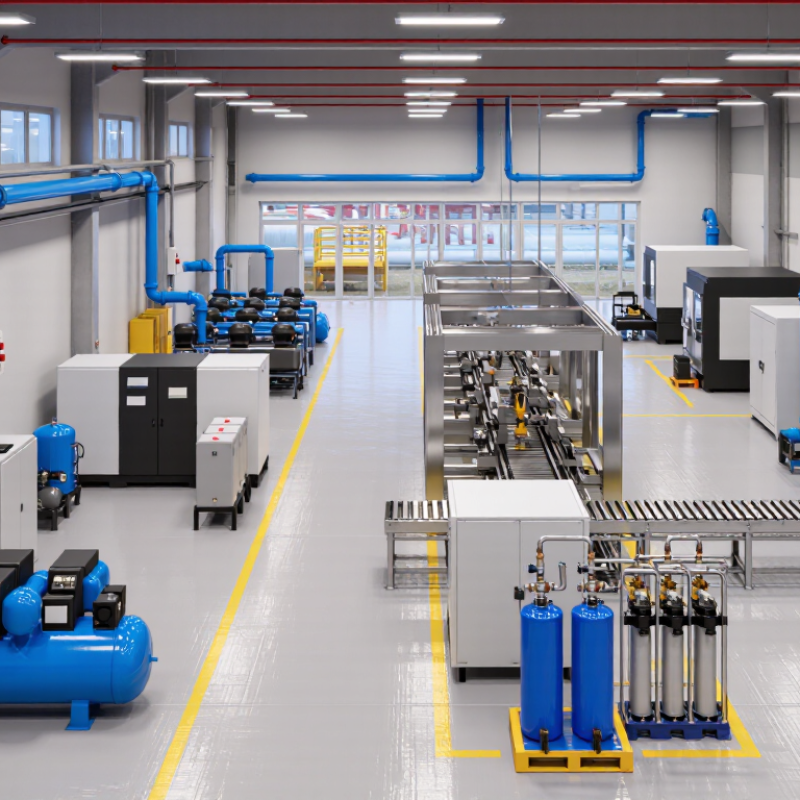
An industrial air system supplies compressed air to tools, actuators, and selected processes. Its core components include a compressor, air receiver, treatment equipment, and a distribution network. The compressor raises air pressure; filters and dryers help control particles and moisture. A receiver stores compressed air and can reduce pressure fluctuations during changing demand. The system’s controls coordinate operation and help maintain the required pressure.
Air quality and pressure should match the equipment’s actual needs. Moisture can corrode pipes or disrupt sensitive instruments, while excessive pressure may waste energy. A production line using pneumatic cylinders may need steady flow during repeated cycles. Instrument air may require tighter control of contamination. There is no single setup for every plant. Even a well-designed system can underperform when demand estimates are off.
Tips: Check filters, drains, and visible pipe joints on a regular schedule. Listen for leaks near couplings. Small leaks matter. Track pressure at distant workstations, not just beside the compressor. A pressure drop can reveal undersized piping or rising demand. Keep maintenance records, but review them critically; a completed checklist does not always mean the system is operating efficiently.
Selecting an industrial air system starts with the work, not a catalog rating. List each tool, actuator, and process, then record required pressure and airflow during peak operation. Short bursts matter. A line that looks adequate on average may falter when several machines start together. Measure demand across a full shift, including cleaning cycles and planned expansion. Avoid sizing from motor horsepower alone; it does not reveal the plant’s actual air-use pattern.
Air quality must match the process. Check moisture, oil carryover, and particles against equipment tolerances and product requirements. Dry, clean air can help prevent corroded valves and rejected finishes, but over-treatment wastes energy. Choose filtration and drying to meet the actual need, and place drains where technicians can reach them. Ambient heat and dust matter, too. A compressor room near a hot furnace may need different ventilation than a cool, clean utility space.
Compare energy use, redundancy, noise, footprint, and service access—not purchase cost alone. Review pressure losses in long or narrow piping, and check whether storage can cover brief demand spikes. Controls should respond to changing loads without rapid cycling. Ask for performance data at expected operating conditions, along with maintenance intervals and parts availability. Numbers deserve checking. A tidy estimate can still miss leaks, seasonal heat, or a shift pattern that changes next month. Revisit assumptions with operators; they often notice small air leaks first.
Industrial plants rely on different air systems for different jobs. Compressed-air networks power tools and actuators, while instrument-air systems supply clean, dry air to controls. Process-air systems support steps such as drying or combustion. Vacuum systems hold parts in place or remove material. Pneumatic-conveying systems move powders and granules through pipes. Each needs suitable pressure, flow, and filtration.
Ventilation systems exchange stale indoor air, and dust-collection systems capture particles near cutting or sanding equipment. Make-up-air systems replace air exhausted from a building. Cleanroom air systems control airborne particles through filtration and pressure management. Regenerative-blower systems provide steady, lower-pressure airflow for applications such as aeration. Details matter. A dusty workshop has very different needs from a packaging room.
Selection should start with the actual task, not just a machine’s maximum rating. Check peak and average demand, pipe distance, moisture, temperature, and how often equipment runs. A pressure gauge near the farthest workstation can reveal losses that a compressor-room reading misses. No layout is perfect; sizing only for peak demand may waste energy during quiet shifts. Maintenance access matters too, because filters and drains are easy to overlook when equipment sits behind a crowded line.
Comparing air systems across industrial sectors means matching pressure, cleanliness, and airflow to the actual process. Automotive assembly often needs steady compressed air for tools, while paint areas need carefully filtered, dry air. Food and pharmaceutical plants may favor oil-free compressors and validated filtration. Electronics production is sensitive to moisture and particles. Different risks, different systems.
A practical shortlist spans ten options: oil-free screw, lubricated screw, reciprocating, and centrifugal compressors; rotary-lobe and turbo blowers; refrigerated and desiccant dryers; filtration trains; and ventilation or exhaust systems. Wastewater treatment often uses blowers for aeration, while foundries may need high-volume extraction alongside compressed air. The U.S. Department of Energy’s Improving Compressed Air System Performance sourcebook estimates compressed air uses about 10% of electricity in U.S. manufacturing. It also notes that leaks can waste 20–30% of compressor output. That is costly air escaping through a small, easily missed fitting.
Selection should begin with measured demand, not a catalog rating. Map pressure at the point of use, check humidity, and note how often loads change. A large centrifugal unit may suit steady demand; smaller staged compressors can handle variable loads better. This comparison is not perfectly neat: some plants need several systems working together. Oversizing still happens, and it is easy to confuse “clean enough” with reliably clean.
| Air System Type | Common Industrial Applications | Typical Operating Range | Key Advantages | Main Considerations |
|---|---|---|---|---|
| Oil-injected rotary screw compressor system | General manufacturing, automotive plants, workshops, and packaging lines | Common plant-air pressures are approximately 7–10 bar(g); equipment ranges vary | Provides a steady supply for continuous industrial demand and is widely used for general-purpose compressed air | Requires appropriate oil separation, filtration, condensate management, and maintenance; not suitable where the process requires oil-free compression without additional controls |
| Oil-free rotary screw compressor system | Food and beverage processing, pharmaceutical production, electronics, and other oil-sensitive processes | Often designed for plant-air pressures around 7–10 bar(g), depending on the application | Avoids oil injection in the compression chamber, which can help reduce the risk of oil contamination from the compressor | Higher purchase cost may apply; air quality still depends on the complete system, including intake air, dryers, filters, storage, and distribution |
| Centrifugal compressor system | Large chemical plants, refineries, steelworks, and other facilities with high, steady air demand | Typically used for medium-to-high flow; pressure depends on compressor staging and design | Well suited to large, continuous flows and can deliver oil-free air from the compression process in appropriate designs | Efficiency and operating stability depend on load; specialist controls and careful capacity matching are important |
| Reciprocating compressor system | Maintenance shops, batch processes, laboratories, and applications needing higher pressure at modest flow | Common industrial models serve a broad range, often from about 7 bar(g) to higher pressures | Can achieve relatively high pressures and is available in configurations suited to intermittent or lower-volume demand | Can produce more pulsation and noise than some alternatives; maintenance intervals and duty-cycle limits depend on the design |
| High-pressure reciprocating system | PET bottle blowing, gas boosting, pressure testing, and specialized process applications | PET blowing systems commonly operate at roughly 25–40 bar(g); other duties vary | Designed to generate pressures well above those used in ordinary plant-air headers | High-pressure equipment needs purpose-rated piping, receivers, safety devices, and controls; it is generally not a substitute for a standard plant-air system |
| Low-pressure blower system | Wastewater aeration, pneumatic conveying, fluidization, and combustion air | Often used at pressure rises of approximately 0.3–1 bar, depending on blower type and duty | Efficiently supplies large volumes of air at relatively low pressure for suitable processes | Not intended to replace compressed air where higher pressure is required; system pressure losses and process demand affect selection |
| Scroll compressor system | Small laboratories, medical or dental facilities, light manufacturing, and localized clean-air duties | Commonly used for lower-flow applications; pressure ratings vary by model | Compact design and comparatively smooth, low-pulsation output can suit smaller installations | Capacity is generally more limited than large industrial screw or centrifugal systems; confirm duty cycle and required air quality |
| Variable-speed compressor system | Facilities with changing demand, such as mixed production lines, packaging plants, and multi-shift operations | Usually configured around the plant header pressure, commonly about 7–10 bar(g) | Adjusts compressor output to changing demand and can reduce unloaded operation when correctly sized and controlled | Potential savings depend on the actual demand profile, control strategy, and operating conditions; it does not remove the need to fix leaks or pressure losses |
| Industrial vacuum system | Packaging, material handling, drying, forming, and vacuum gripping applications | Vacuum level is process-specific and is measured relative to atmospheric pressure or as absolute pressure | Centralized or point-of-use vacuum equipment can serve processes that require suction rather than positive-pressure air | Vacuum is a separate utility from compressed air; pump type, filtration, leakage, and required vacuum level must match the process |
| Instrument-air system with drying and filtration | Process control, pneumatic instruments, valves, and automation in chemical, energy, and manufacturing facilities | Often supplied from a plant-air header; pressure and air-quality limits are set by the connected instruments and process | Dry, appropriately filtered air helps protect pneumatic controls and supports reliable instrument operation | Specify air quality for the actual equipment and operating environment; dryer type, filtration, monitoring, and backup needs vary by site |
Note: Pressure figures are indicative examples, not universal design specifications. Actual requirements depend on the process, equipment, air-quality target, operating profile, and applicable safety standards.
Choosing an industrial air system starts with measured demand, not the largest compressor available. Record pressure and flow during normal shifts, startup, and peak production. This reveals whether tools need steady pressure or only brief bursts. The U.S. Department of Energy’s Improving Compressed Air System Performance: A Sourcebook for Industry reports that system improvements can reduce energy use by 20–50%. That range depends on the facility; it is not a guaranteed saving.
During installation, size pipes to limit pressure loss and place drains where condensate can be removed safely. Keep intake air cool and clean. Leave room around filters and dryers for inspection and replacement. A cramped equipment room may look efficient on a drawing, then make routine work harder. It happens.
Maintenance should include checking filters, drains, couplings, and pressure settings. The Department of Energy’s compressed-air guidance notes that leaks can waste 20–30% of compressor output. Listen near fittings during quiet hours, then confirm suspected leaks with an ultrasonic detector or a simple pressure test. Fixing every leak is rarely realistic; prioritize large leaks and repeat checks. Trend compressor runtime and system pressure each month. If pressure keeps rising to meet demand, investigate the cause before changing settings. A log helps, but it can still miss short production peaks. Compare meter readings with actual output before claiming energy savings.
I&M Industrials Inc.
10 Akron Drive
Greenville SC 29605
Phone: 864-277-2450
GSA Number – GS07F0379Y