2026 Best Air Pressure Gauge for Accurate Measurement
Choosing the best air pressure gauge in 2026 requires more than comparing dial sizes, prices, or digital screens. Accuracy depends on the gauge’s sensor, calibration, pressure range, resolution, and resistance to vibration. A workshop compressor, bicycle tire, laboratory line, and vehicle system may all require different instruments.
Measurement authority Lord Kelvin famously said, “If you cannot measure it, you cannot improve it.” His words remain relevant when a reading differs by only a few PSI. That small difference can affect tire wear, compressor performance, energy use, and equipment safety. A reliable air pressure gauge should provide clear readings under real working conditions, not only on a clean product page.
Look closely.
This guide examines the leading gauges for accurate measurement in 2026. It considers analog and digital designs, calibration certificates, valve compatibility, durability, display visibility, and user handling. Practical details matter. A gauge that fits tightly inside a cramped engine bay may be more useful than one with higher laboratory accuracy. A backlit digital display helps in a dim garage, while a mechanical gauge may remain dependable without batteries.
No product is perfect. Some digital gauges respond slowly in cold weather, and some analog models are difficult to read at an angle. I have also found that advertised accuracy can feel less meaningful when the hose leaks or the connector seals poorly. The comparisons ahead focus on honest performance, supported specifications, and everyday usability. That approach should help professionals, technicians, drivers, and careful home users choose with greater confidence.
What Is an Air Pressure Gauge and How Does It Work?
2026 Best Air Pressure Gauge for Accurate Measurement
What Is an Air Pressure Gauge and How Does It Work?
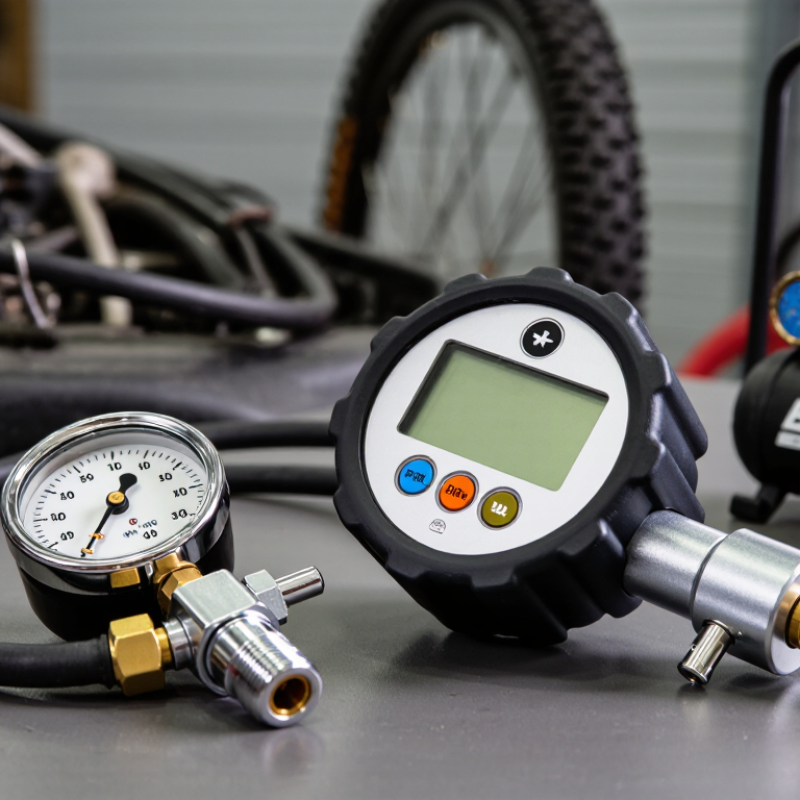
An air pressure gauge measures the force of compressed air inside a tire, tank, hose, or pneumatic tool. Most gauges compare internal pressure with surrounding atmospheric pressure. This reading is called gauge pressure. Some instruments measure absolute pressure instead, which includes atmospheric pressure.
Inside a traditional gauge, compressed air pushes against a curved metal tube or flexible diaphragm. The part bends slightly under pressure. A spring and mechanical linkage convert that movement into a needle position on the dial. Digital gauges use a pressure sensor, then display the result on a small screen. The measurement may appear in psi, bar, kPa, or another unit.
Accuracy depends on more than the gauge itself. I have found that a loose connector can release air during testing. That small hiss may change the reading before the needle settles. Keep the gauge aligned with the valve, press firmly, and wait briefly for a stable result. Check the scale before reading; crowded markings invite mistakes. Temperature also matters because compressed air changes pressure as it warms or cools.
A gauge can look precise and still mislead. Calibration may drift after drops, vibration, or long storage. Comparing it with a certified reference gauge can reveal problems. I would also inspect the hose, seal, and valve connection each time. A careful measurement is rarely dramatic. It is usually quiet, repeatable, and slightly slower than expected.
2026 Best Air Pressure Gauge for Accurate Measurement - What Is an Air Pressure Gauge and How Does It Work?
| Gauge Type | How It Works | Typical Pressure Range | Typical Accuracy | Common Units | Main Advantages | Best-Suited Applications |
|---|---|---|---|---|---|---|
| Bourdon Tube Gauge | A curved metal tube slightly straightens as pressure rises, moving a linkage and pointer. | 0–1,000 bar (0–15,000 psi), depending on construction | Typically ±0.5% to ±2.0% of full scale | bar, psi, kPa, MPa | Simple, durable, does not require electrical power | Compressed-air systems, pumps, industrial equipment |
| Diaphragm Gauge | A flexible diaphragm deflects under pressure and transfers movement to a display mechanism. | Approximately 0–25 bar (0–360 psi) | Typically ±1.0% to ±2.5% of full scale | bar, psi, kPa | Suitable for low pressure and corrosive or contaminated media when properly isolated | Low-pressure air lines, filtration systems, process equipment |
| Digital Pressure Gauge | A pressure sensor converts mechanical strain into an electrical signal processed by a digital circuit. | Commonly 0–700 bar (0–10,000 psi) | Typically ±0.1% to ±0.5% of full scale | psi, bar, kPa, MPa, kgf/cm² | High readability, selectable units, peak-pressure recording on some models | Calibration checks, maintenance, laboratory and field measurement |
| Differential Pressure Gauge | Measures the difference between pressure at two ports rather than pressure at one port relative to atmosphere. | Approximately 0–1,000 mbar differential | Typically ±1.0% to ±2.0% of full scale | Pa, kPa, mbar, inH₂O, inHg | Detects pressure loss and flow resistance across components | Air filters, ventilation ducts, cleanrooms, air-handling systems |
| Vacuum/Compound Gauge | Uses a sensing element calibrated to display both pressure above atmospheric pressure and vacuum below it. | About −1 bar to +20 bar (−14.7 to +290 psi) | Typically ±1.0% to ±2.0% of full scale | bar, psi, inHg, kPa | Combines vacuum and positive-pressure readings in one instrument | Vacuum pumps, pneumatic actuators, service and diagnostic work |
| Panel-Mount Gauge | A permanently installed gauge presents pressure through a front-panel dial or digital display. | Commonly 0–40 bar (0–580 psi) | Typically ±1.0% to ±2.0% of full scale | bar, psi, kPa, MPa | Easy continuous monitoring and clean integration into control panels | Compressors, pneumatic control cabinets, production machinery |
| Test and Calibration Gauge | Uses a high-stability sensor or precision mechanical movement to provide a reference reading. | Commonly 0–700 bar (0–10,000 psi) | Typically ±0.05% to ±0.25% of full scale | Pa, kPa, bar, psi, MPa | High repeatability and traceable calibration capability | Instrument verification, laboratory testing and quality control |
Note: Pressure range and accuracy are typical industry values. Actual performance depends on the sensing element, scale selection, temperature, installation position, pressure pulsation and calibration condition.
Related Posts
-
How to Choose the Best Air Pressure Gauge for Your Needs in 2025
-
Essential Air Pressure Gauge Tips for Accurate Readings?
-
Why Is My Air Compressor Gauge Not Working?
-
10 Essential Tips for Accurately Reading Your Air Compressor Gauge
-
China Best Industrial Air Compressor Manufacturers?
-

Top 10 Air Compressor Repair Tips You Need to Know?