1-800-868-2450
My Account | Cart | Checkout
Why Is Reverse Circulation Drilling Used?
Reverse Circulation Drilling is widely used in mineral exploration because it can collect rock chips quickly and deliver them to the surface through a controlled sample pathway. Compressed air drives the drilling process, while a dual-wall drill pipe carries cuttings upward through its inner tube. At the rig, the sample passes through a cyclone and into a collection bag. The setup is practical, but sample quality still depends on careful handling.
The method is especially useful when teams need broad, consistent coverage across a deposit. A rig can move between drill sites, and crews can collect samples at regular depth intervals. Those chips help geologists identify changes in rock type and mineralization. As a simple field principle puts it: “A fast hole is useful only when its samples remain dependable.” This is an editorially written line, not a verified quotation from a named expert; no source article or expert citation was provided.
Reverse circulation is not perfect. Wet ground, poor sample recovery, or contamination between intervals can weaken the evidence. A bag of chips may look clear on the surface while concealing mixed material. That deserves a second look. Good results rely on trained crews, suitable equipment, documented sampling procedures, and careful interpretation by qualified geologists. The method’s value is not just speed. It is the quality of information teams can defend and use.
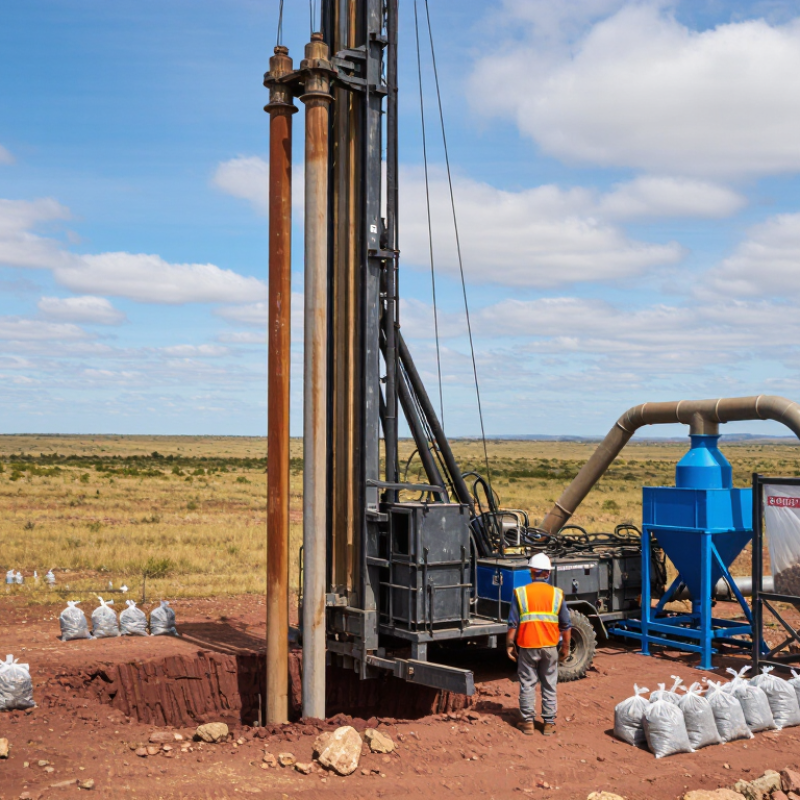
Reverse circulation drilling, often called RC drilling, is a rotary method used to collect rock-chip samples from depth. It uses dual-wall drill rods: an outer tube surrounds an inner tube. Compressed air, or another suitable drilling fluid, travels down between the walls and helps carry cuttings back up through the inner tube. The sample reaches the surface through a hose, then passes through a cyclone and often a splitter for collection.
Unlike core drilling, RC drilling usually returns small fragments rather than an intact cylinder of rock. Each sample represents material from a defined depth interval, so keeping the return stream separated and labelled matters. A field crew may check the splitter, clear blockages, and note whether the sample looks unusually wet or fine. Small details count.
The system can produce samples efficiently in many hard-rock settings, but it is not perfect. Water-bearing ground may reduce sample quality, and poor air circulation can affect how reliably cuttings reach the surface. Fine dust can also obscure visible differences between rock types. RC drilling is best understood as a practical way to recover depth-tagged chips, not a direct view of unbroken rock. A geologist must interpret the chips alongside drilling records and other evidence.
Reverse circulation drilling works by sending compressed air down the outer space of dual-wall drill rods. The air drives a hammer and bit at the hole bottom. Cuttings travel back up through the inner tube, keeping them separate from the air moving downward. At the surface, a cyclone slows the dusty stream, and a splitter divides the sample into bags, often at one-metre intervals. The process is direct. But sample quality still depends on careful handling.
This fast sample return makes RC useful for mineral exploration, where teams need regular, relatively clean chips for logging and analysis. S&P Global Market Intelligence’s World Exploration Trends 2024 reported a 2023 global nonferrous exploration budget of about US$12.8 billion, down 3% from 2022. That figure does not measure RC use; it does show the scale of exploration spending, where drilling efficiency matters. Air pressure, worn seals, and poor cyclone cleaning can still compromise samples. A neat-looking bag is not proof of a perfect sample.
Tips: Check rod connections and clean the cyclone between intervals. Watch for wet cuttings; they can clog the return path or distort sample splits. Record any interruptions rather than quietly treating them as normal.
Reverse circulation drilling depends on a coordinated set of tools, not just a powerful rig. A dual-wall drill rod has an inner tube and an outer tube. Compressed air travels down between them, while rock chips return through the inner tube. This keeps samples away from much of the loose material around the borehole.
The drill bit breaks the rock and directs cuttings into the return path. An air compressor supplies the pressure needed to lift those chips, while hoses and a control system help manage airflow. The returning material passes through a cyclone, which slows the air and drops the sample into a collection point. A splitter then divides the sample into portions for testing and storage. Small parts matter. A worn seal or blocked hose can disrupt the flow and affect sample quality.
The rig, rod handler, and support vehicle keep the drilling operation moving and help workers manage heavy equipment safely. Dust-control systems can reduce airborne particles around the cyclone and sample area. In the field, sample handling is not always textbook-perfect; wet ground or changing rock can make the return less consistent. That is why crews monitor airflow, inspect connections, and record conditions as drilling progresses. A tidy setup helps, but careful checks matter more.
| Equipment | Primary Function | How It Works in RC Drilling | Why It Matters |
|---|---|---|---|
| Reverse circulation drill rig | Provides rotation, feed force, and the support structure for drilling. | The rig advances the drill string while rotating the bit and applying downward force. | Designed for efficient drilling and continuous sample recovery, including in many mineral exploration programs. |
| Dual-wall drill rods | Transmit rotation and compressed air while keeping the sample-return path separate. | Air travels down the space between the outer and inner tubes; cuttings return to the surface through the inner tube. | Separating the airflow and sample-return routes helps reduce sample contamination from the borehole wall. |
| RC hammer and bit | Break rock at the bottom of the hole. | The down-the-hole hammer uses compressed air to drive a piston that repeatedly strikes the bit. The bit cuts and fractures the rock as the drill string rotates. | Effective rock breakage supports relatively fast drilling in many hard-rock conditions. |
| Air compressor | Supplies compressed air to the drilling system. | Compressed air powers the hammer and helps carry rock fragments upward through the inner tube. | Consistent airflow is important for hammer operation and dependable sample transport. |
| Booster compressor | Raises air pressure when additional pressure is required. | Used with the primary compressor in suitable setups to increase pressure delivered to the drill string. | Can help maintain effective hammer performance and cuttings return in deeper or demanding holes, depending on site conditions. |
| Sample hose and cyclone | Direct and separate the returning cuttings at the surface. | The sample stream passes through a hose to the cyclone, where its flow changes direction and solids are separated from much of the air. | Enables a controlled collection point for drilling samples and supports regular sample intervals. |
| Sample splitter | Divides the recovered sample into representative portions. | A rotary or riffle-style splitter separates the sample stream into portions for laboratory analysis and retained reference material. | Consistent splitting helps produce samples suitable for geochemical testing while preserving a portion for checking or storage. |
| Dust-control equipment | Limits airborne dust around the sample collection area. | Dust collectors, enclosures, or water-based controls may be used, selected according to the drilling setup and site requirements. | Helps improve working conditions and reduce the loss of fine material during sample handling. |
| Rod handling equipment | Moves and connects drill rods during drilling and withdrawal. | Mechanical handling systems or suitable lifting equipment assist with adding and removing rods. | Supports efficient rod changes and helps manage heavy drill-string components safely. |
| Sample bags and labeling supplies | Hold and identify collected samples. | Samples are placed into labeled containers or bags, with interval and hole information recorded for tracking. | Accurate labeling and handling maintain sample traceability from the drill site to the laboratory. |
Reverse circulation drilling is used when exploration teams need rock chips quickly across a large target. Compressed air travels down the outer drill pipe, while chips return through the inner tube to a cyclone and sample bags. This contained return path helps limit contamination compared with open-hole air drilling, but it cannot prevent every sampling error. Geologists can inspect chips at the rig and record changes between intervals. That makes RC useful for testing many locations efficiently. The Australian Bureau of Statistics reported about A$4 billion in mineral exploration expenditure in 2023–24 (Mineral and Petroleum Exploration, Australia). When exploration budgets are substantial, faster sampling can help teams focus follow-up work.
RC drilling also produces samples suitable for routine geological and geochemical analysis, and the method can penetrate hard formations. The International Energy Agency’s Global Critical Minerals Outlook 2024 projects that demand for critical minerals for clean-energy technologies could nearly triple by 2030 under its net-zero emissions scenario. More deposits will need careful evaluation. Still, RC is not a cure-all. Wet ground can complicate chip recovery, and poor collection practices may mix material between intervals. It is also less suited than core drilling when geologists need an intact rock cylinder to study structures. On site, crews check sample recovery, bag labels, and dust control; small lapses can weaken an otherwise useful dataset.
Reverse circulation drilling is widely used in mineral exploration when crews need representative samples quickly. Compressed air pushes rock chips up an inner tube, helping keep them separate from material around the drill rods. The method suits large programs that need many holes across broad, remote areas. A geologist can examine chips from regular depth intervals and adjust the next hole based on what appears. Speed matters.
It works best in relatively dry, competent ground, where samples travel cleanly to the surface. But conditions can change. Water, soft clay, or fractured zones may slow the return flow, clog equipment, or mix material between intervals. That weakens confidence in the sample record. RC drilling also produces noise and airborne dust, so crews need practical controls and careful site planning. Access for a large rig and compressor can be difficult on narrow tracks or steep ground. Another limitation is detail: chips reveal rock type and mineral indicators, but not the continuous structures visible in a core. Choosing RC solely because it is faster can be a poor trade. The right method depends on the question, ground conditions, and how much geological detail the project needs.
I&M Industrials Inc.
10 Akron Drive
Greenville SC 29605
Phone: 864-277-2450
GSA Number – GS07F0379Y