1-800-868-2450
My Account | Cart | Checkout
Choosing the right Circuit Breaker Manufacturers is not simply a price comparison. It affects equipment protection, maintenance costs, and operational safety. A dependable manufacturer should demonstrate consistent product quality, clear technical documentation, and verified testing procedures. Look for evidence of compliance with relevant standards, such as IEC or UL requirements, where applicable to your market and installation.
Experience matters in practical conditions. A manufacturer serving commercial buildings may not understand the demands of railway systems, data centers, or heavy industrial plants. Ask about short-circuit ratings, operating cycles, temperature performance, enclosure options, and coordination with other protective devices. These details matter when a breaker must interrupt a fault without damaging nearby equipment. Request test reports, factory quality records, and traceable product information.
Small details reveal reliability.
Supplier support deserves equal attention. Can the technical team explain trip curves clearly? Are replacement parts available after several years? Does the company provide installation guidance and responsive after-sales service? A low purchase price can become expensive when documentation is incomplete or delivery schedules change. Still, no checklist is perfect. Marketing claims may sound impressive, while actual performance depends on design, testing, installation, and maintenance.
Compare manufacturers using evidence rather than promises. Review independent certifications, customer references, production capabilities, and warranty terms. If possible, inspect samples or arrange third-party testing before a large purchase. The best choice may not be the most famous brand. It is the manufacturer that consistently matches your electrical requirements, risk level, budget, and long-term service expectations. Careful questioning takes time. It can prevent a costly decision later.
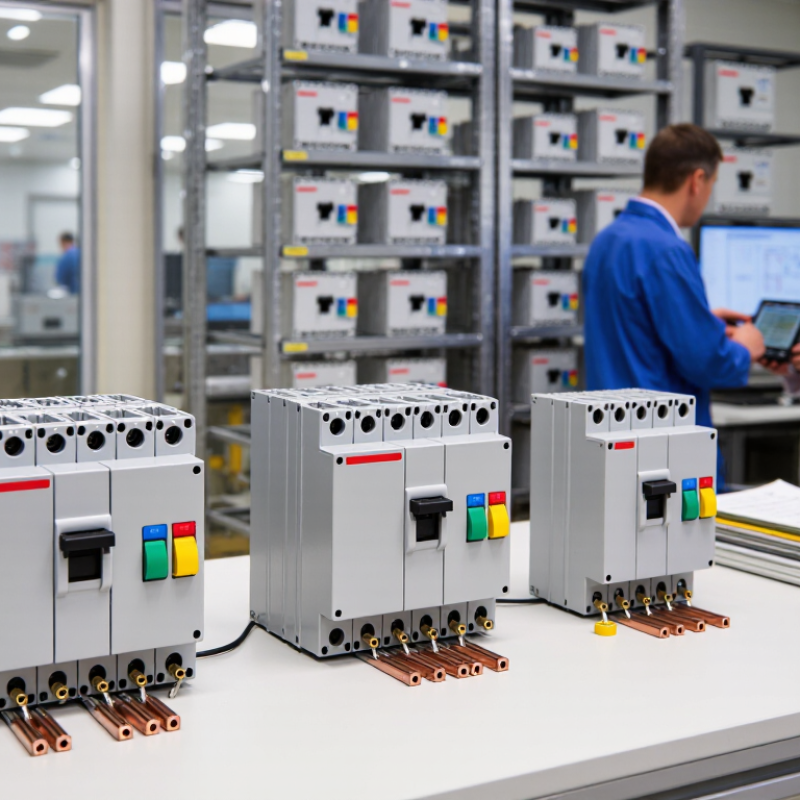
Before comparing circuit breaker manufacturers, define the job the breaker must do. Record system voltage, continuous load current, available short-circuit current, pole count, and the required trip curve. Then check the installation: a hot control cabinet, frequent motor starts, vibration, dust, or moisture can change performance. Small details matter. A breaker beside a warm drive may need derating; a pump circuit may need to ride through starting current without nuisance trips.
Use fault and arc-flash studies to set protection requirements, not guesswork. IEEE 1584-2018’s arc-flash calculation method uses inputs such as fault current, voltage, conductor gap, and protective-device clearing time. Those values help engineers assess equipment and worker exposure.
Compare each manufacturer’s published interrupting rating with the site’s calculated fault current at the installation voltage, and verify coordination with upstream and downstream devices. For low-voltage equipment, IEC 60947-2 provides a recognized framework for breaker performance and testing. Check the exact product documentation; ratings can vary by voltage and configuration.
Ask suppliers for test evidence, temperature limits, trip-unit settings, and accessory compatibility for the actual application. Include future load growth, but do not oversize protection just to leave “room.” That can weaken fault protection.
I have seen specifications overlook enclosure heat; it is an easy mistake to make, and worth revisiting before procurement. Sources to consult include IEEE 1584-2018 and IEC 60947-2, alongside a site-specific short-circuit and coordination study.
A certificate is useful only when it matches the circuit breaker being offered. Check the manufacturer’s quality-management certification, then confirm its issuing body and validity through the issuer’s records. Do not rely on a logo printed on a brochure. Small detail, big difference.
Product compliance needs closer inspection. The certificate should identify the exact model or product family, rated voltage, current, breaking capacity, and applicable test standard. Compare those details with the nameplate and technical datasheet. If a report covers one frame size but the quotation lists another, ask for written clarification before purchasing. A vague answer is a reason to pause.
Request recent type-test reports from a competent testing laboratory, and check that the tested configuration matches the supplied breaker. Also review routine inspection records, production traceability, and documented change control. These records help show whether quality checks continue beyond the initial certification. For a project, keep copies with the procurement file; they can save time during inspection or maintenance.
Paperwork cannot reveal every production problem. That is easy to forget when schedules are tight. A factory audit or sample inspection may provide useful additional evidence, especially for critical installations. Verify documents independently, and have a qualified engineer confirm that the selected ratings suit the actual system conditions. Even careful checks leave some uncertainty, so record unanswered questions rather than treating a certificate as a guarantee.
| Assessment Area | What to Check | Relevant Standard or Evidence | Questions to Ask | Good Sign |
|---|---|---|---|---|
| Product standard for industrial circuit breakers | Confirm that the breaker type and intended application are covered by the declared standard. | IEC 60947-2 applies to circuit breakers used in low-voltage switchgear and controlgear. | Does the test documentation identify the exact product series, ratings, and standard edition? | Documentation matches the model being quoted and states applicable ratings and test conditions. |
| Product standard for household and similar applications | Check that the standard is appropriate for the breaker’s intended use rather than assuming all breakers share one standard. | IEC 60898-1 covers AC circuit breakers for overcurrent protection in household and similar installations. | Is the product intended for household or similar use, and does its documentation support that application? | The manufacturer clearly identifies the intended application and the applicable product standard. |
| North American product compliance | For projects requiring North American requirements, verify the applicable listing or certification for the exact product. | UL 489 is a standard for molded-case circuit breakers and related products. Check the relevant certification directory for listing details. | Can the supplier provide a verifiable listing record for the exact model and configuration? | The listing details, ratings, and product markings agree with the supplied documentation. |
| Third-party test evidence | Review test reports or certificates, including their scope, issuing organization, and product identification. | Reports should identify the tested product and relevant standard; an independent laboratory’s accreditation can be checked with its accrediting body. | Who performed the tests, what was tested, and does the report cover the model offered? | Reports are traceable and cover the product family, ratings, and configurations being purchased. |
| Quality management system | Check whether the manufacturing site has a current quality management system certificate and whether its scope is relevant. | ISO 9001 specifies requirements for a quality management system; it does not certify a circuit breaker’s electrical performance. | Is the certificate current, issued by an accredited certification body, and applicable to the manufacturing site? | The certificate’s scope and site details are clear and can be independently verified. |
| Product ratings and application suitability | Compare rated voltage, current, frequency, pole count, and breaking capacity with the project specification. | Use the product datasheet and applicable standard documentation; breaking capacity and rating terminology may depend on the standard. | Are the stated ratings suitable for the system voltage and the prospective fault current at the installation point? | Ratings are clearly stated, consistent across documents, and suitable for the specified installation. |
| Environmental and operating limits | Check temperature, altitude, enclosure, and installation conditions that can affect performance or rated capacity. | Refer to the manufacturer’s technical documentation and any applicable derating instructions. | Are derating factors and operating limits documented for the actual installation conditions? | Technical guidance addresses the project’s ambient conditions and mounting arrangement. |
| Marking and traceability | Verify that product labels, model numbers, ratings, and production identification correspond to supplied records. | Check the product marking requirements in the applicable standard and the manufacturer’s traceability documentation. | Can each delivered unit or production batch be traced to its model and manufacturing records? | Labels are legible and consistent with the datasheet, test evidence, and purchase documents. |
| Documentation and change control | Review datasheets, installation instructions, test documents, and how product changes are communicated. | Request controlled, current document revisions applicable to the quoted product. | How are design, component, or manufacturing-site changes assessed and communicated? | Documents have clear revision details, and changes affecting compliance are managed transparently. |
| Final compliance verification | Confirm requirements for the destination market and project before purchase; a marking or certificate alone may not establish every local approval. | Check applicable national regulations, project specifications, and certification or listing directories. | Are all required approvals valid for the destination market and the exact product configuration? | Compliance claims are supported by verifiable records and match the project’s regulatory requirements. |
Note: Standards and approval requirements vary by product type, application, and destination market. Verify current requirements and certificates with the issuing organization before purchasing.
How to Choose the Best Circuit Breaker Manufacturers?
Compare Product Quality, Performance, and Testing Capabilities
A polished datasheet is not proof of a dependable breaker. Compare the exact model’s rated current, operating voltage, and short-circuit breaking capacity with your installation conditions. IEC 60947-2 provides a recognized framework for testing low-voltage circuit breakers, including performance under short-circuit conditions. Ask manufacturers for the applicable test reports, not just a standards logo. Check that the tested configuration matches the poles, accessories, and enclosure you plan to use. Small differences matter.
Performance claims need numbers. Review trip curves, selectivity data, and temperature-rise results for the intended operating range. Ask how the manufacturer verifies repeatability across production batches, and whether reports identify test conditions and equipment. Testing conducted by an ISO/IEC 17025-accredited laboratory can strengthen confidence in measurement competence, though accreditation alone does not guarantee product quality. Look for evidence tied to the specific product and test.
Inspect samples for consistent terminal finishes, clear markings, and secure mechanical action. Request endurance and dielectric test records, plus details on incoming material checks and final inspection. A manufacturer should explain failures plainly and show corrective actions. That conversation can feel less impressive than a glossy brochure, but it is often more useful. Be cautious when reports omit ratings, test setup, or sample identification. A missing detail may have an innocent explanation; still, ask before comparing suppliers.
Compare product quality, performance, and testing capabilities using the evidence that matters.
How to use this chart: The 1–5 values are illustrative assessment weights, not test results or ratings of any manufacturer. Ask for product-specific datasheets, applicable IEC/UL compliance evidence, test reports, and clear rated-current and breaking-capacity specifications. Requirements vary by breaker type and application.
A circuit breaker is only as dependable as the support behind it. Ask who reviews fault-current calculations, answers installation questions, and handles failure analysis. Request a sample technical file, including test reports, coordination curves, and clear instructions for selecting accessories. Check whether engineers can respond during commissioning, not just during sales. IEC 60947-2 defines requirements for low-voltage circuit breakers, but a standards reference alone does not prove that a supplier’s documentation is complete or useful. Ask for evidence tied to the exact product configuration. Small detail. Big difference.
Lead-time promises deserve equal scrutiny. McKinsey’s 2020 report, Risk, Resilience, and Rebalancing in Global Value Chains, estimated that companies could expect supply-chain disruptions lasting a month or longer every 3.7 years. The finding is not breaker-specific, but it supports checking how suppliers manage disruption. Ask for quoted production and shipping times, stock availability, and updates if a date slips. Warranty terms need the same close reading: confirm coverage duration, exclusions, labor costs, and the process for returning a failed unit. Compare written terms, not reassuring phrases. I have seen buyers focus on price and overlook freight or replacement delays; that is an easy mistake, and it is worth questioning.
A circuit breaker’s purchase price tells only part of the story. Compare its rated voltage, current capacity, interrupting rating, and intended operating conditions with your system’s requirements. Ask for test reports and clear documentation, not just a product sheet. Those details help verify that the device suits the actual installation.
Look beyond the initial quote. Check warranty terms, replacement-part availability, technical support, and typical lead times. A dependable supplier should explain how products are tested and how quality issues are handled. Ask what happens when a shipment is delayed or a unit fails inspection. The answer can reveal more than a polished brochure.
Keep records. A simple comparison sheet can track lifecycle costs, delivery performance, and service response times. If possible, speak with customers who have used the equipment under similar loads. One favorable reference is not proof of consistent performance. No checklist catches everything. Even experienced buyers can misjudge future maintenance needs, so leave room for uncertainty. The best choice balances verified technical fit with support you can rely on years after installation.
I&M Industrials Inc.
10 Akron Drive
Greenville SC 29605
Phone: 864-277-2450
GSA Number – GS07F0379Y