1-800-868-2450
My Account | Cart | Checkout
Choosing a Commercial Spot Light for a global project takes more than comparing prices or wattage. Buyers need to consider beam angle, color temperature, brightness, and how the fixture will be installed. A narrow beam can highlight a product display, while a wider beam may suit a reception area. Small details matter. A sample that looks bright in a supplier’s showroom may feel harsh in a darker shop. Check the light in conditions close to the real space whenever possible.
Reliable sourcing also depends on practical questions. Ask about materials, driver specifications, dimming compatibility, product testing, and warranty terms. Request clear technical documents, and confirm that the quoted model matches the drawings and sample. Photographs help, but they are not enough. Packaging, lead times, and communication across time zones can affect a project just as much as the fixture itself. No checklist removes every risk. Even careful buyers sometimes overlook a mounting detail or assume that two similar models perform alike.
The following seven buying tips offer a grounded way to compare suppliers and products before placing an order. They focus on performance, quality checks, supplier evaluation, and shipping considerations. The right choice depends on the room, budget, and project schedule, so there is no universal winner. Be prepared to revise your shortlist when new information appears. That is not wasted effort; it is part of making a better-informed decision.
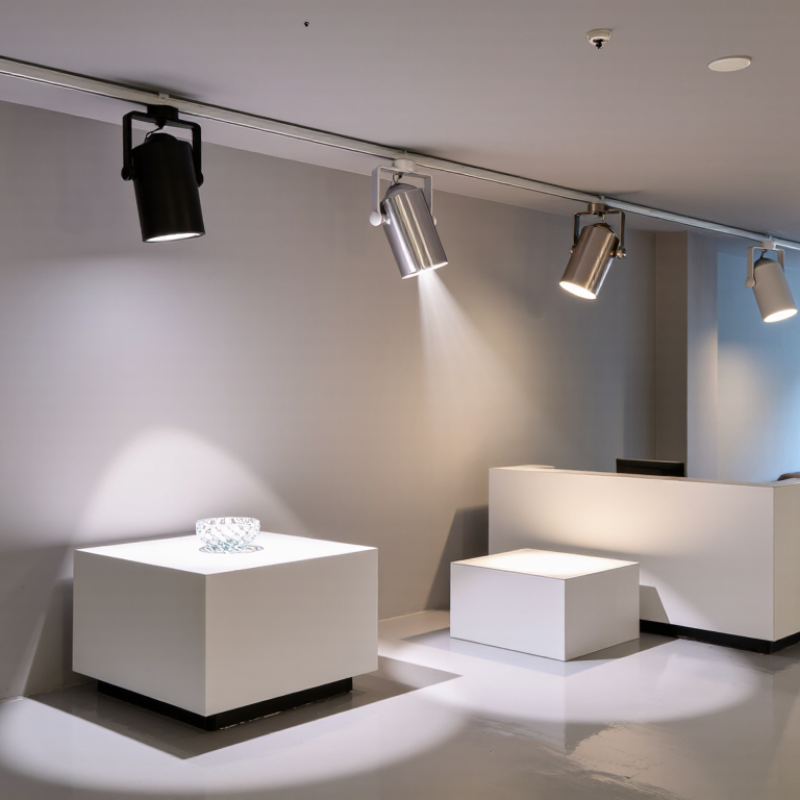
Before choosing a commercial spotlight, define what the light must do. A narrow beam can highlight a small product display, while a wider beam can cover a counter or wall section. Note the target’s size, mounting height, and distance from nearby surfaces. A three-metre ceiling and a narrow shelf need different settings from a high ceiling and a broad feature wall. Write down the task before comparing fixtures. It sounds obvious, but buyers often start with wattage or appearance.
Beam angles between 15° and 60° cover many retail and hospitality needs. Around 15°–25° can create a focused accent on a sculpture or merchandise shelf. Angles near 30°–40° often suit medium-sized displays. A 50°–60° beam spreads light more broadly, though it may reduce the visual emphasis on one object. These ranges are practical starting points, not guarantees. Check the manufacturer’s beam data and, where possible, review a lighting layout or test sample at the intended mounting height. Watch for dark gaps, glare, and light spilling onto neighboring displays. Even careful calculations can miss the way finishes reflect light. A quick on-site check can reveal that.
A spot’s wattage tells you how much power it uses, not how much useful light reaches the target. Two 25 W fixtures may produce very different results. One could deliver 2,000 lumens, while another delivers 2,800. That difference is easy to miss on a basic quotation. Compare delivered lumens and lm/W, not wattage alone. Delivered lumens describe the fixture’s output after losses from its optics and diffuser. Lumens per watt show how efficiently it converts electricity into light. Neither figure tells the whole story.
Ask for test data measured at the complete fixture, rather than relying only on the LED chip’s claimed output. Check the beam angle too. A narrow beam can make a display look bright, but leave nearby surfaces dim. For a high ceiling, compare the expected light at the target height and review the photometric file if available. Small differences matter. Also confirm that figures apply at the intended color temperature and operating conditions. Heat can reduce output, especially in compact housings with limited ventilation. Supplier documents sometimes omit these details; that is worth questioning, even when the price looks attractive. A brief sample test in a room with similar ceiling height can reveal whether the quoted output suits the actual application.
For retail and hospitality spotlights, color errors appear on skin, timber, and product packaging.
Set CRI at 80 or higher as a practical minimum. ENERGY STAR’s lamp specification uses 80 as its minimum CRI threshold. Higher can help, but CRI alone does not tell the full story. DOE’s 2022 Solid-State Lighting R&D Opportunities report treats color quality as more than a single metric. Check samples under the actual merchandise and finishes. Reds can still look dull.
Specify CCT in kelvin, not vague terms such as “cool white.”
ENERGY STAR’s lamp specification lists defined options including 2700K, 3000K, 3500K, 4000K, 5000K, and 6500K. A 3000K beam often feels warm on wood and skin; 4000K can look cleaner in a display area. Neither is universally better. Compare the beam with nearby fixtures, or a carefully chosen spotlight may clash with the rest of the room.
Ask suppliers for CRI and CCT values on the quotation, then test a sample on-site.
Small differences matter. I would also check the red tones in the actual products, not just a chart. That extra check takes time, and it can still miss how customers perceive the display.
Before ordering commercial spotlights, match the driver’s input rating to the installation—not just the fixture’s wattage. IEC 60038:2009, Standard Voltages, identifies 230/400 V and 120/208 V among standardized supply voltages, with 50 Hz and 60 Hz systems used in different markets. Check the driver label for its full input range, such as 100–240 V AC, and confirm it explicitly supports both frequencies. A voltage match alone is not enough. Some drivers are rated for 50 Hz only, while others accept 50/60 Hz.
Ask the supplier for the driver datasheet and verify the exact model, not just a general product-family sheet. For a 230 V, 50 Hz site, confirm the rated input covers local voltage variation; for a 120 V, 60 Hz site, check that 120 V falls within range. Also review dimmer compatibility and startup behavior, since these can differ between driver models.
A practical oversight: buyers sometimes approve a sample tested on one supply, then ship units with a different driver revision. It happens.
Record the voltage, frequency, dimming method, and driver model in the purchase specification, and request a test report using those conditions. A few minutes checking the label can prevent flicker, shutdowns, or costly replacements.
A spot light’s IP rating describes protection against solids and water, not overall product quality. Under IEC 60529, the first digit indicates solid-particle protection; the second indicates water protection. IP65, for example, is dust-tight and tested against water jets, but it does not mean the fitting can be submerged. Looks can deceive.
Check the rating for the complete fixture, not just its housing. A cable gland, glass seal, or adjustable joint can affect protection after installation. Ask for an IEC 60529 test report that names the exact model and test conditions. If the light will sit beneath an exposed canopy, compare the tested water exposure with the site’s likely rain and cleaning methods. A rating alone cannot account for poor installation.
Confirm destination-market requirements separately. Electrical safety, electromagnetic compatibility, labeling, and documentation rules may differ by country or sales region. Request current conformity documents and verify that model numbers, voltage, and product configuration match your purchase order. For outdoor projects, ask whether any required approval covers the complete luminaire and its intended use. Paperwork can be messy; that is a reason to check it early, not to assume a familiar mark covers every market.
I&M Industrials Inc.
10 Akron Drive
Greenville SC 29605
Phone: 864-277-2450
GSA Number – GS07F0379Y