China Top 10 HVLS Motor Manufacturers for Global Buyers
Global buyers are reassessing industrial ventilation as energy costs, heat exposure, and workplace comfort become harder to ignore. The International Energy Agency reports that electric motor systems consume roughly half of global electricity. That figure makes motor efficiency a purchasing issue, not a minor specification.
Hvls Motors sit at the center of this discussion. Their performance affects airflow, starting current, noise, service life, and operating cost. The U.S. Department of Energy’s fan-system guidance stresses that efficient equipment must be evaluated as a complete system. Motor selection alone is insufficient. Controllers, blade design, installation height, and maintenance also matter.
Small details reveal larger differences. A warehouse fan may run above workers for twelve hours daily. A weak controller can create speed instability, while poor bearings may increase vibration within months. AMCA 208 introduces the Fan Energy Index, helping buyers compare fan efficiency under defined conditions. ISO 13349 also provides recognized terminology for fan performance and testing.
This guide examines China’s top ten HVLS motor manufacturers for global buyers. The selection considers motor technology, production capacity, testing practices, customization, certifications, export experience, and after-sales support. Public company information and industry reports provide the foundation, but supplier claims still require verification.
No ranking is absolute. Buyer priorities vary.
A manufacturer serving a large logistics center may not suit a smaller factory. Some companies publish detailed test data; others provide limited evidence. That gap deserves attention. Requesting efficiency curves, duty-cycle results, warranty terms, and sample testing remains practical. The strongest supplier is not always the largest. It is the one that can support dependable performance from quotation to long-term operation.
What Are HVLS Motors and Why Do They Matter?
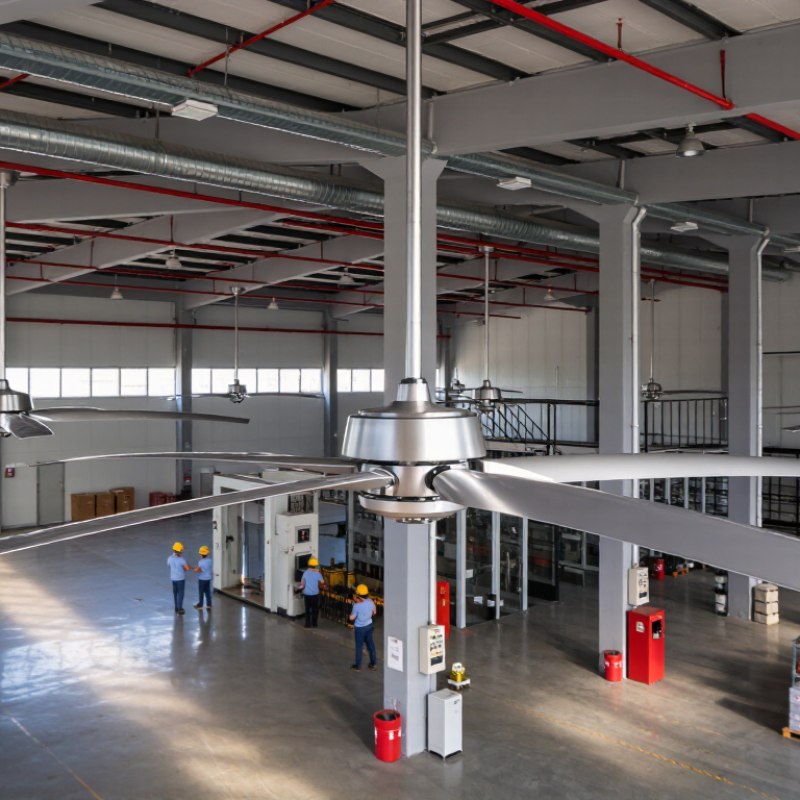
HVLS motors are the power units behind high-volume, low-speed fans. These systems move large amounts of air across warehouses, workshops, farms, and distribution centers. Unlike small, high-speed fans, they create broad, gentle airflow with lower operating noise. The motor turns large blades steadily, helping reduce hot ceiling pockets and improve air mixing near workers. This matters because comfort can affect concentration, equipment conditions, and daily energy use. In practice, the motor is not merely a rotating component. It controls reliability, speed response, maintenance needs, and the fan’s service life.
For global buyers, motor selection deserves more than a catalog comparison. A qualified purchasing team should check torque, rated power, voltage, frequency, protection class, insulation, controller compatibility, and local certification requirements. Thermal performance also matters in dusty or humid buildings. A motor that performs well in a clean showroom may struggle beside loading docks. Ask for test records, efficiency data, installation guidance, and spare-part support. Experience shows that unclear documentation can create expensive delays. That lesson is easy to ignore. It should not be.
Tips: Confirm the site temperature, ceiling height, airflow target, and available power before choosing a motor. Request measurable noise and efficiency data, not broad marketing claims. Check warranty terms carefully. They may vary by region. Finally, compare total ownership cost, including controls, inspections, downtime, and replacement parts. The cheapest motor may not remain economical after several hot seasons.
| No. | Manufacturer Capability Dimension | Typical HVLS Motor Data for Global Procurement | Why This Dimension Matters | Relevant Standard or Technical Basis |
|---|---|---|---|---|
| 1 | Motor Technology | Permanent-magnet synchronous motors, brushless DC motors, and induction motors are used in HVLS fan systems. Direct-drive permanent-magnet designs are increasingly selected because they eliminate the mechanical gearbox. | A direct-drive design can reduce mechanical wear, transmission losses, lubrication requirements, and maintenance points compared with geared systems. | IEC 60034 series; motor design documentation |
| 2 | Typical Rated Power | Commercial HVLS fan motors commonly fall within approximately 0.37–2.2 kW, depending on fan diameter, blade design, airflow target, installation height, and operating speed. | Motor power should be matched to the complete fan system rather than selected independently. Oversizing may increase purchase and operating costs, while undersizing can reduce airflow performance. | Application-specific engineering data |
| 3 | Operating Speed | HVLS fans normally operate at low rotational speeds, commonly below 200 rpm, with the exact range determined by fan diameter and aerodynamic design. | Low-speed operation produces large volumes of air with relatively low noise and helps create destratification and air-mixing effects in large spaces. | Fan system performance testing |
| 4 | Input Voltage and Frequency | Common global input configurations include 110–240 V single-phase and 220–480 V three-phase systems at 50 or 60 Hz. Actual compatibility depends on the motor controller and installation market. | Confirming voltage, phase, and frequency before ordering prevents incompatibility with local electrical infrastructure and reduces the need for additional transformers or control equipment. | IEC 60038; local electrical codes |
| 5 | Speed Control Method | HVLS motors are commonly controlled by variable-frequency drives, dedicated permanent-magnet motor controllers, or integrated electronic speed controllers. Typical control functions include variable speed, soft start, overload protection, and fault indication. | Variable-speed control allows airflow to be adjusted for seasonal conditions, occupancy levels, comfort requirements, and energy-management strategies. | IEC 61800 series; controller manufacturer data |
| 6 | Ingress Protection | IP54 is a common baseline for protected industrial motor applications, while IP55 or higher may be specified for dusty, humid, or washdown-prone environments. The required rating depends on the complete motor and enclosure design. | A suitable IP rating helps protect windings, bearings, sensors, and control components against dust and water ingress, improving reliability in warehouses, workshops, and agricultural buildings. | IEC 60034-5 |
| 7 | Insulation and Thermal Class | Class F insulation is widely used in industrial motors, providing a 155°C insulation-system temperature class. Some designs use Class H insulation, rated at 180°C, for more demanding thermal conditions. | Higher thermal capability can provide additional temperature margin, but actual motor life also depends on ambient temperature, ventilation, loading, and controller settings. | IEC 60085; IEC 60034-1 |
| 8 | Duty Rating and Bearings | S1 continuous-duty operation is generally appropriate for HVLS fans that run for extended periods. Sealed or permanently lubricated bearings are commonly used, with bearing selection based on load, speed, temperature, and expected service life. | Continuous-duty capability and correctly selected bearings are essential for facilities that operate fans for many hours each day, especially in distribution centers and production buildings. | IEC 60034-1; ISO 281 |
| 9 | Efficiency and Energy Use | Motor efficiency varies by technology, rated load, speed, and controller. High-efficiency permanent-magnet systems can reduce electrical losses, particularly in applications with long annual operating hours. | Energy consumption should be evaluated using measured system input power and annual operating hours, not motor nameplate efficiency alone. | IEC 60034-2-1; IEC 60034-30-1 where applicable |
| 10 | Global Compliance and Documentation | International buyers commonly request electrical ratings, wiring diagrams, performance curves, efficiency data, EMC information, test reports, installation instructions, spare-parts lists, and declarations for applicable market regulations. | Complete technical documentation simplifies certification, customs clearance, installation, commissioning, maintenance, and after-sales support across different countries. | CE, EMC, RoHS, UL or other market-specific requirements |
| Buyer Note: HVLS means “High Volume, Low Speed.” An HVLS motor is the drive unit that rotates a large-diameter fan at low speed to move substantial air volumes across large indoor or semi-open spaces. Final motor selection should be based on the complete fan assembly, including diameter, blade geometry, airflow, static pressure, mounting height, ambient conditions, control system, and local electrical requirements. | ||||